
For a few brief glorious months, Canada was declared to be free of any traces of Asian Long Horned Beetles after a campaign of many years and more dollars. Then, distressingly, in mid-2013 the announcement was rescinded: a worker near Pearson Airport found a large insect on his car windshield. It was an Asian Long Horned Beetle. A new quarantine and cleanup began. The government would like you to keep an eye out for these beetles and advise them quickly if you find any. The tricky part is not every Long Horned Beetle in Ontario is an Asian one.
Why are They Called Long Horned Beetles?
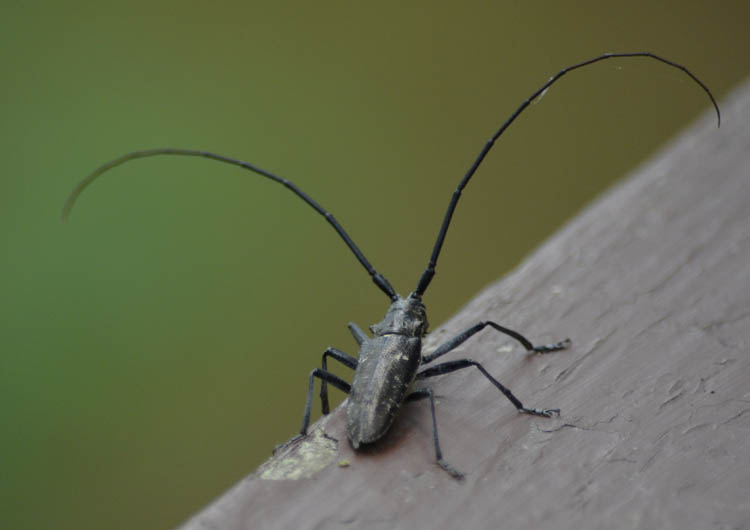
It’s not the best name, admittedly, because unlike Rhino beetles, these ones have no “horns” at all. What they do have is startlingly long antenna. Like this one:
What’s the Most Common Long Horned Beetle in Ontario
There are a surprising number of types of Long Horned Beetles. Well, surprising to me because I’ve rarely seen any.
The most common native Ontario type seems to be the White Spotted Sawyer. “Sawyer” is used in its original meaning as one who saws wood. According to the Royal Alberta Museum website, “The larvae make enough noise when chewing their way through the wood that it sounds like a distant saw, hence the name.” (Apparently they sometimes snack on log cabins!)
How Can I Tell If My Find is a White Spotted Sawyer?
Your best bet is to get confirmation from an etymologist. However, there is one noted field mark: According to BugGuide.net the scutellum is white. “(Scutellum is the little triangle at the front of the elytra, or wing covers.)”
If you squint at my photo closely, you’ll see this small white triangle sort-of in the centre of the “neck.”
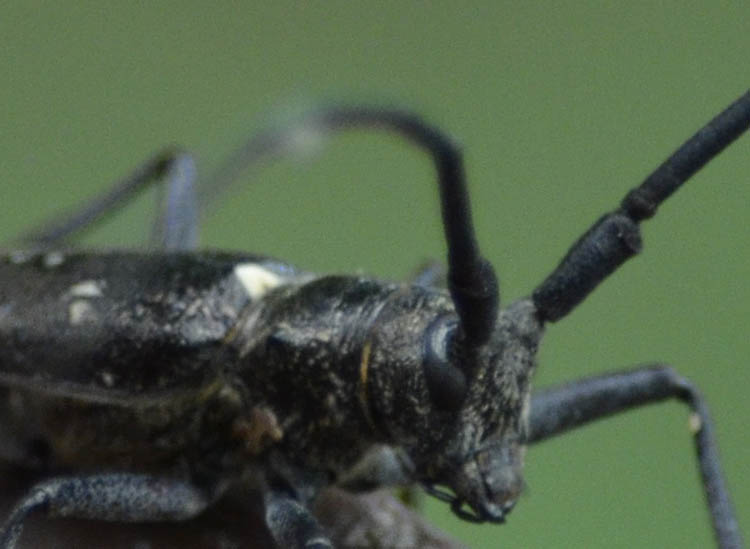
The number of other white spots can vary widely. It can have only the scutellum spot or it can be heavily dappled.
What Do White Spotted Sawyers Eat?
Again, according to BugGuide.net, the larvae “excavate galleries in coniferous trees, often after they are damaged by a fire, storm, etc.” Balsam fir, spruces and white pines are common hosts.
We’ve actually seen the work the grubs do and it’s both impressive and kind of gross. A particularly bad stormed felled a 90-foot-plus white pine near my relatives’ cottage. While sawing it up, my strong-armed relative found the chambers bored out by the larvae. The larvae themselves were large and thriving.
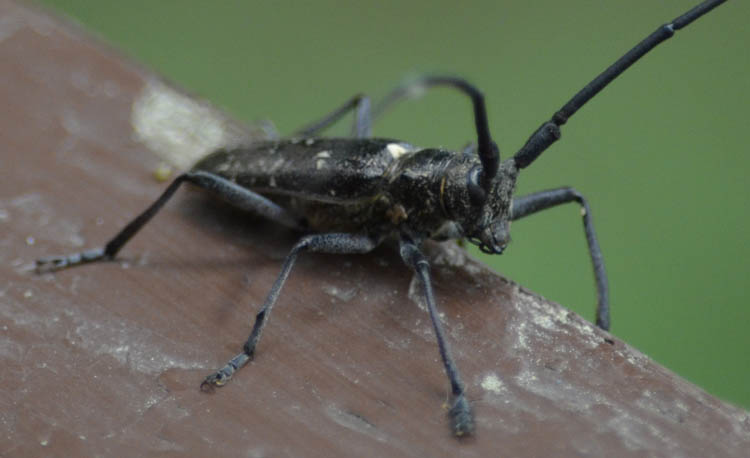
According to the Natural Resources Canada website adults can damage young twigs on healthy trees by feeding on the tender bark. The larvae are both “phloeophagous” and “xylophagous” because they feed on both phloem and woody tissues. The tunnels from the young can damage wood cut for lumber. Foresters need to take precautions to avoid having cut but not used logs damaged by the beetles.
The NRC lists the host trees as
- balsam fir
- black spruce
- eastern white pine
- jack pine
- red pine, and
- white spruce
You can see photos of the larvae at http://tidcf.nrcan.gc.ca/en/insects/factsheet/900
Are White Spotted Sawyers Dangerous?
No.
They can bite but according to the Royal Alberta Museum website they rarely do and they don’t secrete any poisons or weird digestive enzymes they just pinch.
Odd Fact Courtesy of BugGuide.Net
Apparently, White Spotted Sawyers are attracted to the scent of bitumen in the Alberta oil sands because it smells similar to diseased and damaged conifers. The beetles are attracted to the scent when looking for a place to lay their eggs.
Related Reading
- Western Conifer Seed Bug Seeks Warm Winter Home
- To see images of the Asian Long-Horned Beetle and to read more about it, please visit the Center for Invasive Species Research website.
Join In
Have you ever seen a Long Horned beetle? Did it startle you enough to spill your lemonade, like I did? Please share your experiences with a comment.