
When my children were too young to teach, I would vigorously search out and remove any nightshade plants from our yard. While I vaguely remembered reading that you have to eat quite a few of the candy-coloured red, yellow and orange fruit to die, I wasn’t taking any chances. I had grown up calling the plant with the pretty purple and yellow flowers “deadly nightshade.” I certainly didn’t want to test the name.
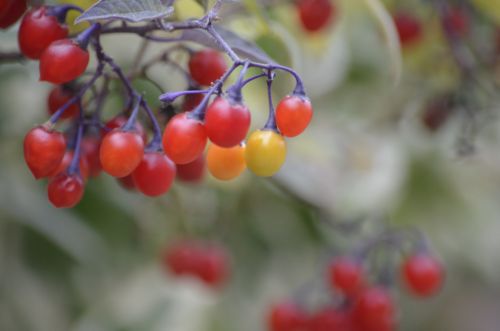
Years have passed and my children know what is not safe to scarf down. A few nightshade plants have grown. I didn’t pull them all out because I think the flowers and berries are actually rather beautiful. One vine twines through a euonymus bush against our fence. Another has sent sprays of berries out over a limestone retaining wall.
Living in a suburban world of grass lawns and pruned trees, I suppose I should have given some thought to how the plants were getting here in the first place, but I was too busy chasing toddlers to think much beyond “Wait. Don’t. It will—“ and then get a towel to dry them off.
Cardinal Consumes Bright Red Berry of Bittersweet Nightshade
Then this weekend, I was watching a male cardinal. He was snooping around eating something off the peach tree branches, then poking amongst the pinks and the Echinacea in the garden bed. I was trying to take his photo, when I clearly saw him pluck a single ruby red berry.
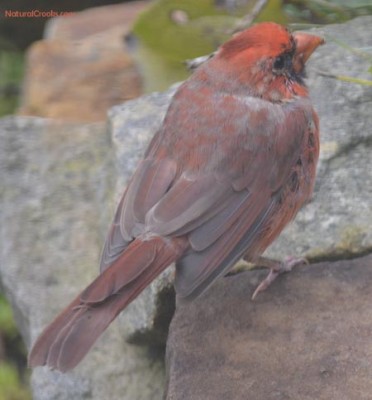 He tapped it on the limestone at his feet and seemed to rip it open. Thanks to an annoying Echinacea branch, I couldn’t quite see what he did. Did he eat the flesh? Did he eat the seeds? Or did he disdain both and just leave it there.
And now that I do have time to think about it, how are all these nightshade plants getting a start in my yard? They don’t have fluffy airborne seeds like the dandelions and thistles that also want to make their home here. We don’t have a stream to float incoming berries. My kids are so suspicious of them, they wouldn’t even pick them, much less carry them home to plant.
Bird poop seems like a chief suspect.
Since I couldn’t see whether the cardinal ate the berry or the seeds, I had to look for information elsewhere. As usual, I did a bit of a poke and search around the internet and flipped through my field guides.
Bittersweet but Still Somewhat Deadly Nightshade
The first thing I discovered is that the plant I have called “deadly nightshade” for decades isn’t named that. The plant is actually Bittersweet Nightshade, Solanum dulcamara. Bittersweet Nightshade is an alien, not native to Canada. The one called Deadly Nightshade has black berries.
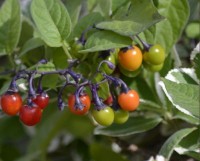
Both nightshades are toxic and should never be eaten. The Bittersweet Nightshade is less severely toxic. My Peterson Field Guides to Eastern / Central Medicinal Plants says that it contains “toxic alkaloids and steroids” and can kill by “paralysis and weakened heart.” So keeping the kids away from the berries and plants was a good idea.
Can Birds Bite Bittersweet Nightshade, or Will They Bite It?
Having identified the plant properly, I continued trying to find out whether birds can eat the seeds safely. Birds can often eat things that would kill us. For instance, have you ever seen a vulture eating 3-day-old road kill? I’d suggest that we humans skip trying that.
(And of course, my wise Mom once observed when a chipmunk was eating a wild mushroom, “I wouldn’t eat it just because the chipmunk is. Who knows if it’s going to run off, hide and die?” Even wild animals can make toxic mistakes.)
Various internet sources stated that birds do eat Bittersweet Nightshade berries, but to me one source was more authoritative than the others. A study done by Kent State University in Ohio in the 1950s actually examined the contents of the stomachs of dead birds. They found bittersweet nightshade berry seeds in the stomachs of 4 cardinals. So cardinals do eat nightshade berries. Whether they should or not.
On the US Federal Fire Service website, it states “In a controlled experiment, bittersweet nightshade was found to be highly palatable to cedar waxwings, [and] moderately palatable to American robins and white-crowned sparrows….”
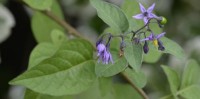 According the various other sources including government weed control sites, birds eat the nightshade berries and spread the seeds in their droppings. This has lead to a widespread distribution of the plants.
So now I have another reason to allow one or two bittersweet nightshade plants to twine around my garden. They produce bright blossoms and attractive berries, and they provide food for visiting birds. I’ll keep the plants in check, though, because I know not everyone likes them.
Join In
Have you seen a bird eating nightshade berries? Did it eat more than one? Please share your observations with a comment.