
When the leaves are down and I can see the stems and twigs of the bushes and trees, I often spot interesting gnarls and barks. I also often see something that looks much more gross. In fact, it reminds me of shriveled, dried up raccoon poop: but it’s wrapped around a twig.
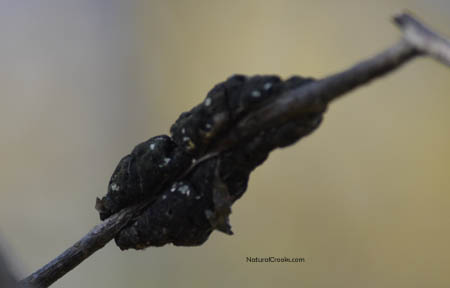
The ugly black growth is apparently a type of fungus called Black Knot, Apiosporina morbosa. It spreads by spores which are released in March through June, depending on the temperature and humidity. It often “blooms” after a warm rain. The spores are spread by wind and splashing rain water.
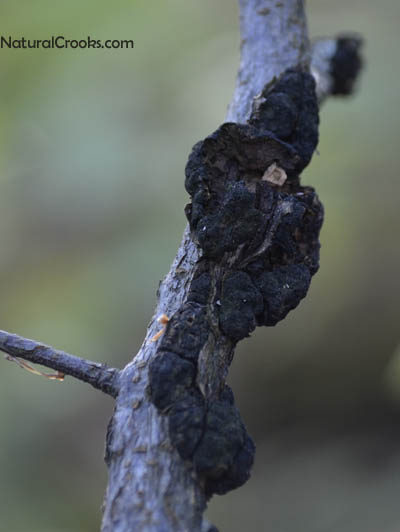
After infecting a new twig or branch, the fungus first causes a small brown wart-like growth. Within two years, it becomes the black eyesore that is so obvious during a walk through the woods. Severely infected trees may never grow very large.
It is common on wild Chokecherries, Sand Cherry, Pin Cherries and Black Cherries.
The fungus is a problem for orchards and has to be carefully controlled primarily by pruning.
Of course every mystery somewhat resolved like this one just leads me to another. What kind of shrubs or small trees are these things I blithely call “cherries?” Are they Chokecherries? Bird cherries? Pin cherries? Something else? I guess I’ll have to resolve that one of these days too.
Join In
What did you think the first time you saw Black Knot? Do you have a fruit tree that is affected by it? Please share your experiences with a comment.