
This winter of 2013 I’ve spent many happy hours rambling along the shores of north-western Lake Ontario. The large numbers and types of diving ducks have given even the greyest coldest winter day something worth watching. As I became better at identifying the more colourful divers, I started noticing one that was decidedly plain. It was a diving duck, a bit larger than most and somehow chunky, that was almost all black. After reading an article in the Toronto Star, I took a closer look and noticed it had a patch of white on its wing and a white comma-shaped curl around its eye. Ah-ha!
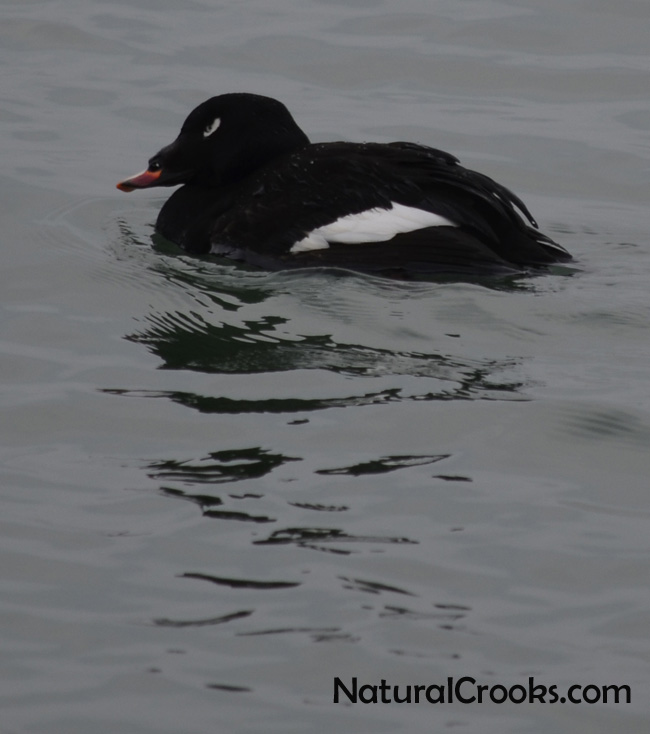
The singularly unimaginative name of this rather simply coloured duck is White-winged Scoter.
Why White-winged Scoter? Why Not Comma-eye? Or Bumpy-beak?
Frankly, I’m not sure this is the best possible name for this duck. According to Peterson’s Field Guide, the white on the wing is not always visible when the bird is on the water. The vivid white comma around the eye of the male Scoter is really obvious, though. However, the female doesn’t have the comma, just some random lighter patches on her face. The mature male also has a funny knob at the base of the beak, a bit like a Mute Swan. But it’s surprisingly difficult to see at a distance, and these ducks tend towards the shy side of the spectrum.
My next puzzle was: what is a Scoter? I’m familiar with the word scooter, and rather envy the kids who bomb around the block on them. Scoter though is new to me. (Although there are three types of Scoters in my Peterson’s: Surf, Black and White-winged.) Off I went to the internet to take a gander. Rats. Merriam-Webster says the origin of the word is unknown. It’s been in use since about 1674 though! (For those who are puzzled by that these birds are also in Europe and Asia.)
Webster’s did offer the interesting tidbit that the White-winged Scoters are also called Velvet Scoters and are worldwide in distribution. Velvet sounds way cool. Frankly the ones I saw, though, looked like most of the nap had been worn off years ago.
The Oxford Dictionary online says it’s possible that the word is a mistaken form of the word “sooter” referring to the black plumage. After over 300 years it’s hard to know.
White-winged Scoters on Lake Ontario at J.C. Saddington Park and Bronte Outer Harbour Marina
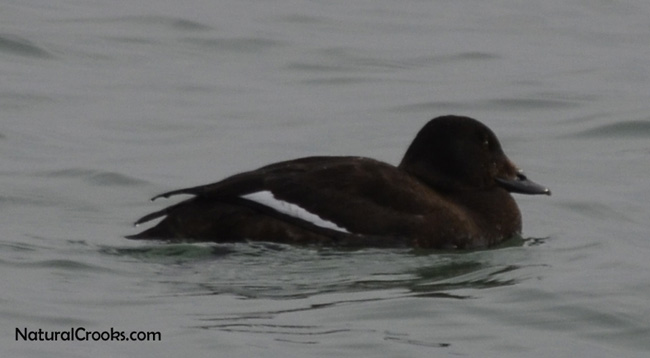
This one is the female. She’s brown and has less white on the face and a more normal bill.
I’m pretty sure I’ve seen these Scoters from several parks in Toronto, Mississauga and Oakville this winter. They often were fairly far out, however, and in the early days I didn’t know what to look for in the markings. However, I know for sure I saw them off J.C. Saddington Park in Mississauga and Bronte Outer Harbour marina in Oakville. That’s where I took the out-of-focus photos.
Unlike the Greater Scaup, Long-tailed Ducks, Bufflehead and Mergansers, I rarely saw more than 1 or 2 pairs of these ducks on a ramble. They may raft somewhere in the Lake, but if so it wasn’t near shore when I was out for a walk. Since all the books talk about them wintering on the oceans, it’s also possible that they aren’t so common on the inland lakes.
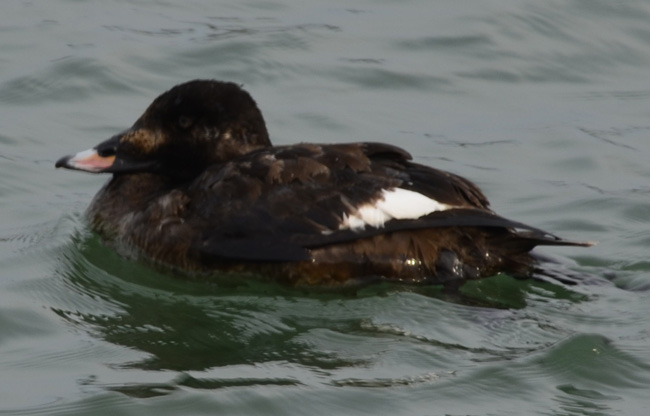
Thanks to the Bird Id people at Outdoor.Ontario.net I also found out this one is a second year male White-winged Scoter. He’s developing the bill and eye markings.
Like most of the diving ducks I’ve watched this winter, White-winged Scoters are known to eat mollusks. According to the Cornell University website, these Scoters will eat zebra mussels. They also have been known to eat crustaceans, some vegetation and fish.
Related Reading
- What is this Crazy Black Duck with the White Beak Doing in LaSalle Park, Burlington, Ontario?
- Common Goldeneyes Duck into View at Arkendo Park, Oakville ON
Join In
Have you seen Scoters? Were they White Winged or one of the other types? Please share your experiences with a comment.