
This spring (2025) I had hoped to finally get to Rondeau Provincial Park with a goal of seeing a Prothonotary Warbler or even better a nesting pair. As life happens, I injured my leg so I wouldn’t be able to walk the trails. Then, while vicariously birding by reading OntBirds Rare Bird Discord, I saw an astonishing report: a male Prothonotary Warbler was singing daily in a flooded forest and swamp area along Safari Road in southern Ontario less than an hour’s drive away.

Why Is It Called Safari Road If It’s In Ontario? And Why Is Part of the Road Closed?
I admit at first I couldn’t understand why a road not far from Cambridge Ontario was called Safari Road. Then I realized it led to a park called African Lion Safari.
A section of the road has had to be closed because it is underwater more often than dry. If I understand correctly, the adjacent land has always been swampy. And now, for whatever reasons, the wet section has expanded. There are quite a few drowned trees at one end of the washout. They have been dead long enough to permit birds and animals to excavate nest holes and dens inside.

If you look at the top of this photo, you can see the warbler half inside a tree hollow, checking it as a possible nesting site.
When I visited, I watched Eastern Bluebirds, Tree Swallows, and European Starlings using nest cavities in some of these trees. And this kind of drowned forest and marsh habitat is appealing to Prothonotary Warblers.

There is a risk that the road may be re-opened by changing the drainage in the area.

The male is singing near the potential nesting hole, hoping to attract an interested female.
Personally, I greatly enjoyed the chance to visit this habitat by walking down the dry road past the road closure blocks to where the water begins. I had to use a rollator walker but I was able to park only a hundred yards from the road closure (to keep away from private driveway entrances etc.) and then roll down to the wetland on a relatively smooth safe surface and I could stop every few yards to rest my injured ligament.
Are Prothonotary Warblers Particularly Beautiful?
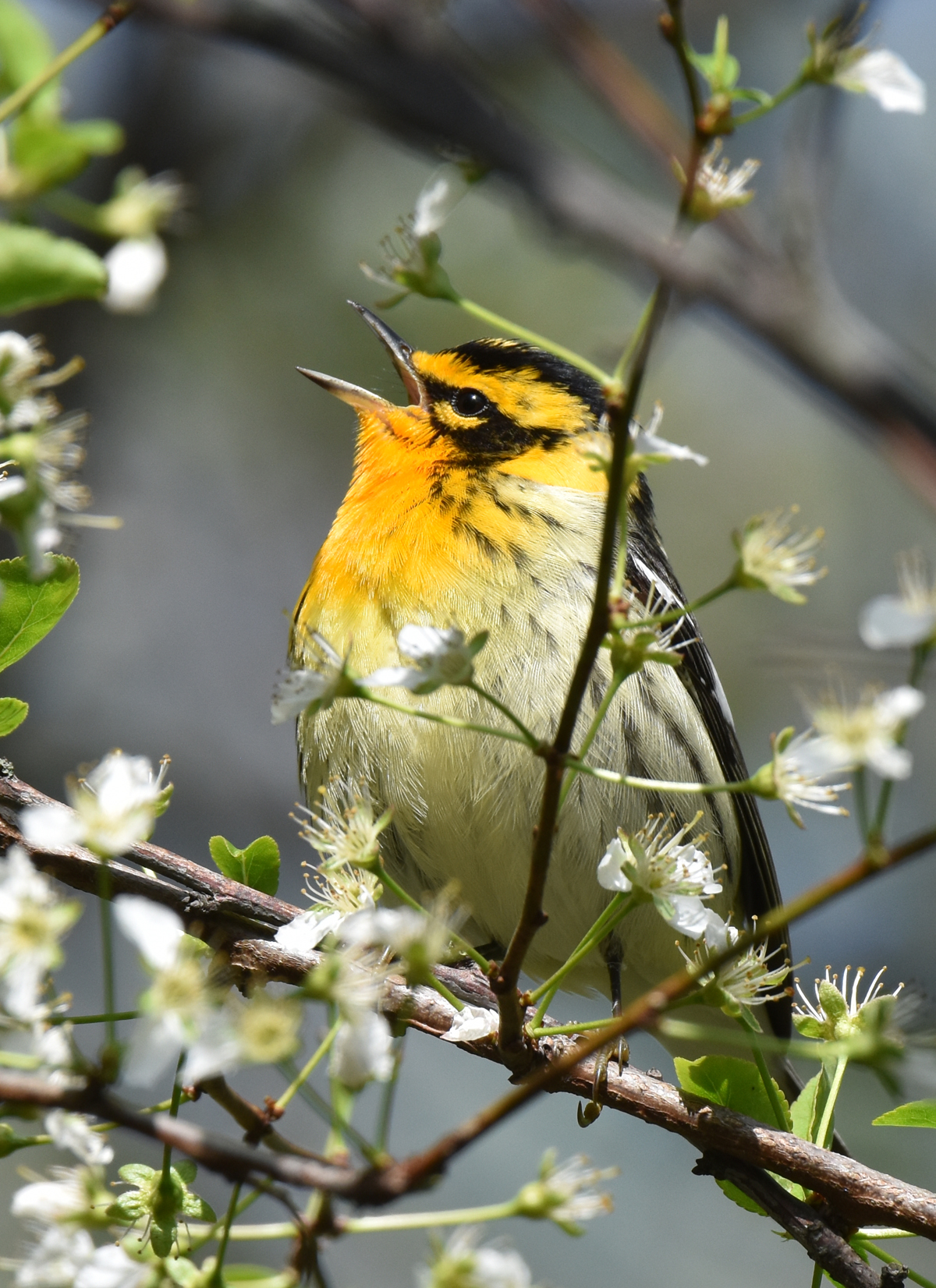
I have seen several dozen types of warblers and they vary greatly in plumage colours and designs. I have seen many that are more vividly marked than Prothonotary Warblers. For example, I find Blackburnian Warblers very eye-catching.
Prothonotaries have very simple colouring. They are primarily yellow with dark steely-blue-grey wings. There eyes are often described a shiny black beads or buttons. Due to the set of their bills, they look somewhat “happy” in expression.

One of the most photographed poses of these Warblers is of a male perched over calm still water mirroring it from below. So when I actually saw a bird in this position, it was like watching a calendar photo come to life!
Are Prothonotary Warblers Endangered?

I could see he had some white feathers in his tail.
In Ontario, the Prothonotary Warbler is listed as an endangered species. Southwestern Ontario is the northern-most edge of its range. The birds live mostly in the eastern United States. They are not endangered in the USA but are listed as “of concern.” Their preferred habitat is diminishing due to human activities.
A Happy but Sad Encounter with a Prothonotary Warbler

In the mid-morning sunshine, he sang steadily as he flew around a fairly large area of the drowned trees beside the swamp.
While I was very, very happy to get such a good look at a male Prothonotary Warbler in its preferred habitat, I was also saddened. He sang day after day but there was no female to hear him and join him. An entire breeding season was lost and with it the chance to increase the numbers of these attractive birds. I can only hope that next year he will have more luck, even if it means he does not return to this location that was so convenient for me (and many others!) to visit.

I hope the next time I meet one of these warblers, he will be successfully raising chicks with a partner.
Related Reading